Why Turboflare
Turborepo remote cache should be boring infrastructure: deploy it, set a token, point CI at it, and move on.
Alpha
Turboflare is still in the works. Expect rough edges and breaking changes.
- Interested in using it? DM @wishee0.
- Found a bug? Open a bug report.
- Want a feature? Open a feature request.
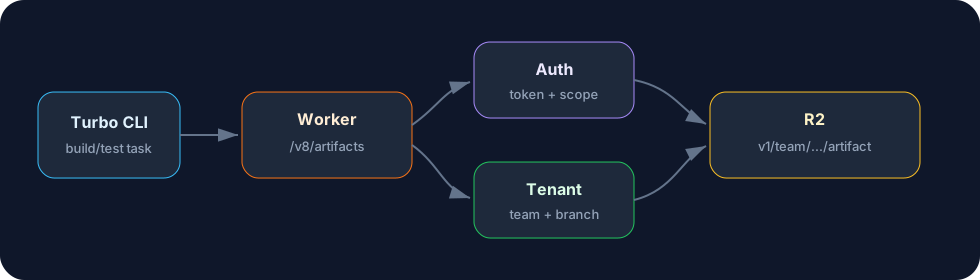
Quick context:
- Turborepo hashes each task from inputs, command, env, and outputs.
- Remote caching lets one runner upload a task result and another runner restore it.
- This matters most in CI because fresh runners usually start with no local cache.
Measured in Turboflare's own CI run 27145453178:
| CI step | Time | Meaning |
|---|---|---|
| no remote cache | 95s |
rebuild everything |
| cold Turbo seed + upload | 94s |
compute once, store artifacts |
| remote-cache rebuild | 2s |
restore matching task hashes |
Thanks to Vercel for making Turborepo and the remote cache protocol easy to use and self-host. If Vercel Remote Cache fits your project, use it. Turboflare is for teams that specifically want the cache Worker and artifacts in their own Cloudflare account.
| Need | Turboflare gives you |
|---|---|
| Fast global reads | Cloudflare Workers + optional Cache API |
| Durable artifact storage | R2 as source of truth |
| Simple auth | static tokens, scoped tokens, optional D1 tokens |
| Ops control | R2 lifecycle, bounded cleanup, internal purge/stats |
| Turbo support | standard remote cache behavior, no client fork |
See the Feature Matrix for the complete implemented feature list.
If this sounds like your team
| You have... | Turboflare helps by... |
|---|---|
| PRs rebuilding the same packages | restoring cached Turbo tasks from Cloudflare. |
| cache data that must stay in your org | keeping artifacts in your R2 bucket with your own tokens. |
| open-source forks or untrusted PRs | pairing read-only tokens with branch-aware cache policies. |
| teams split across regions | serving repeated reads from nearby Cloudflare PoPs. |
| too much infra for a build cache | replacing cache servers with one Worker and one R2 bucket. |
| client projects that cannot share data | namespacing each repo, customer, or branch independently. |
Choose a setup path
| Path | Use when | Start here |
|---|---|---|
| Clone-free setup | you want Wrangler to ask and fill values | Getting Started |
| Agentic setup | you want an AI coding agent to do it safely | Agentic Setup |
| Manual setup | you want every Cloudflare step explicit | Deploy |
Terminal
pnpm dlx create-turboflare
The shortest manual version
Terminal
pnpm install
pnpm deploy
wrangler secret put TURBO_TOKEN --config apps/cache-worker/wrangler.jsonc
Terminal
export TURBO_API="https://<worker-name>.<subdomain>.workers.dev"
export TURBO_TOKEN="<same token>"
export TURBO_TEAM="team-name"
turbo run build --cache=local:,remote:w
rm -rf .turbo
turbo run build --cache=local:,remote:r
Turboflare stores Turbo task cache artifacts. It does not deploy your application code.
Where to go next
| If you want to... | Read this |
|---|---|
| deploy the Worker | Deploy |
| configure Turbo clients | Turbo Client Setup |
| understand the system shape | Architecture |
| tune R2 and cleanup | Storage & Retention |
| set up teams and tokens | Auth & Teams |
| operate production | Operations |