Architecture
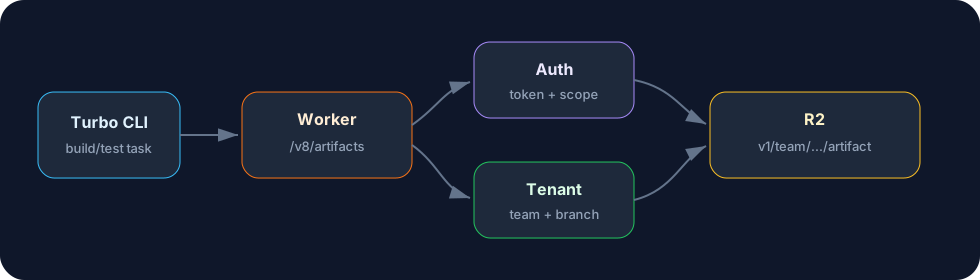
Turboflare keeps the hot path intentionally small: authenticate, resolve tenant, construct a storage key, stream the artifact store. In the default setup, that store is R2.
Modules
| Module | Responsibility |
|---|---|
app/router.ts |
route dispatch and shared Turbo auth flow |
auth/* |
static tokens, scoped tokens, D1 token auth, internal admin auth |
tenancy/* |
team and branch resolution |
routes/* |
Turbo cache protocol and internal admin endpoints |
storage/* |
R2/KV storage, keys, metadata, cleanup, D1 index |
observability/* |
Analytics Engine datapoints |
rate-limit/* |
optional Rate Limiting binding enforcement |
routes/internal/* |
admin stats, purge, token management, cleanup |
Hot path
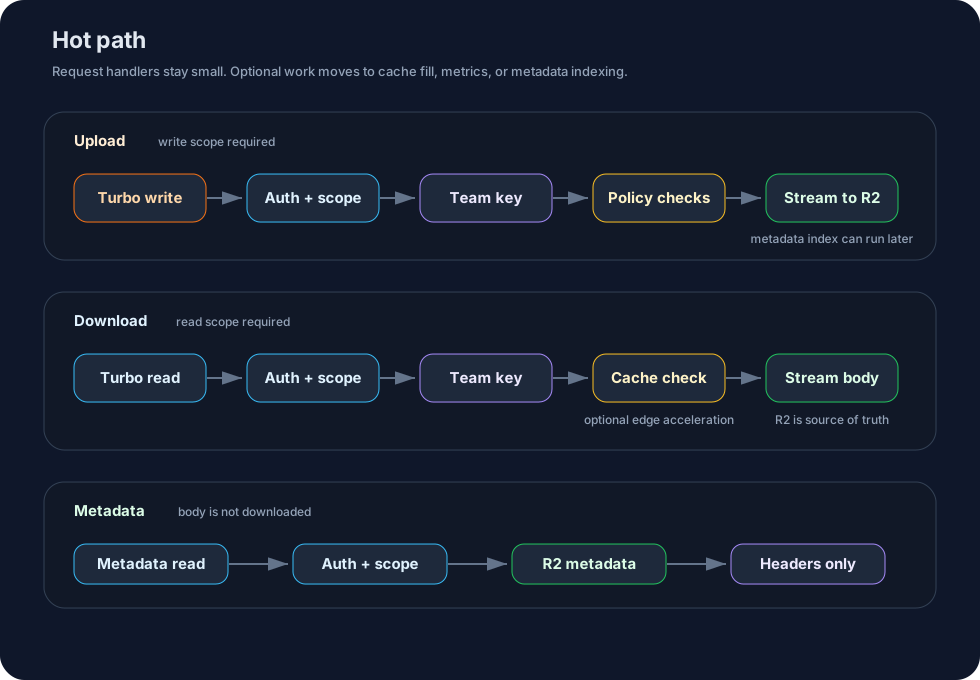
Uploads validate auth, resolve tenancy, enforce policy, then stream directly into the artifact store. Downloads validate auth, resolve tenancy, optionally check edge cache, then stream the artifact body. Metadata reads avoid downloading the object body.
KV mode uses the same routing and key model, but it is an explicit fallback. KV buffers uploads, caps values at 25 MiB, and cannot do metadata-only HEAD without reading the stored value. R2 is recommended for real cache artifacts.
Storage key design
Default:
v1/team/{teamKey}/artifact/{artifactId}
Branch:
v1/team/{teamKey}/branch/{branch}/artifact/{artifactId}
Design goals:
| Goal | Why |
|---|---|
| versioned prefix | future migration path |
| team prefix | cheap team stats/purge |
| branch namespace | optional PR isolation |
| encoded parts | safe R2 object keys |
Source of truth
R2 is source of truth in the default setup.
Cache API is read acceleration only. D1 artifact index is metadata only. Analytics Engine is observability only.
R2 artifact exists -> cache hit possible
Cache API entry exists -> faster read path
D1 index row exists -> admin/search metadata
Analytics datapoint exists -> reporting only
Optional Cloudflare products
| Product | Binding | Why it is used |
|---|---|---|
| R2 | ARTIFACTS |
durable artifact storage with streaming for normal Turbo uploads; default source of truth |
| KV | ARTIFACTS_KV |
explicit small-artifact fallback for simple experiments |
| D1 | TOKEN_DB |
dynamic token auth: hashed tokens, teams, scopes, expiry, revocation, audit log |
| D1 | ARTIFACT_INDEX |
queryable artifact metadata for admin/search/reporting; not required for cache hits |
| Cache API | none | optional edge acceleration for small repeated reads |
| Analytics Engine | ANALYTICS |
non-blocking metrics for hit/miss/status/upload/event traffic |
| Rate Limiting | RATE_LIMITER |
optional per-token or per-team request limiting |
Each optional binding can fail closed or be absent without changing the default Worker + R2 cache behavior. Artifact bodies live in R2/KV. Token state lives in D1 only when TOKEN_DB is enabled. Metrics live in Analytics Engine only when ANALYTICS is bound.
Why not pre-warm?
Warmup is not a Worker concern. Turbo artifacts are produced by running repo tasks. A Worker cannot checkout a repo or run pnpm turbo run. If an on-push build already runs Turbo with remote writes, that build naturally populates the remote cache.